
The electric vehicle (EV) revolution is here. Consumers and manufacturers alike demand longer range, faster charging, and absolute safety. However, building a powerful battery pack involves a major challenge: securely and efficiently connecting hundreds of individual cells.
Traditional welding methods, like some conduction heating, often fall short. They can have a large heat-affected zone, potentially damaging sensitive cell components. Meanwhile, inconsistent weld quality affects performance, and slow heating speeds limit production.
Now, induction heating technology offers a powerful solution. This mature thermal management approach brings precision, control, and efficiency to critical battery manufacturing processes. This article explores how induction heating tackles these core challenges, enhancing both battery safety and manufacturing productivity.
How Induction Heating Transforms EV Battery Manufacturing
Building a high-performance EV battery pack requires incredibly precise and reliable thermal processes. This is where induction heating shines.
Unlike conventional methods that apply heat externally, induction heating offers a fundamentally different, more controlled approach. This section breaks down the science behind this technology and its direct application to solving critical challenges in battery production.
The Core Principles of Induction Heating
At its heart, induction heating is a simple yet powerful process. A high-frequency alternating current passed through a copper coil generates a rapidly alternating magnetic field.
When you place an electrically conductive material—like the copper or aluminum used in battery busbars and tabs—inside this field, it induces countless tiny electrical currents, called eddy currents, within the part itself.
This phenomenon, electromagnetic induction, causes the material to heat up from the inside out. Essentially, the part becomes its own heat source.
This “internal generation” of heat delivers several game-changing advantages for battery manufacturing:
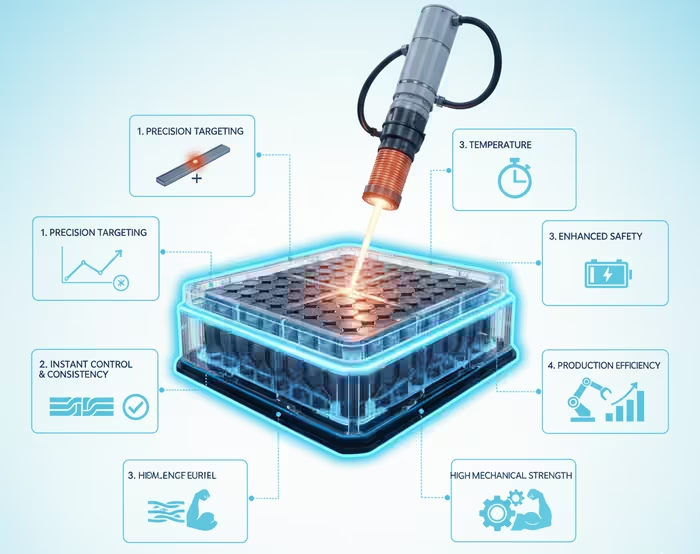
- Precision Targeting: The energy focuses precisely on a specific area, often just millimeters wide. This creates a minimal heat-affected zone (HAZ). As a result, the surrounding sensitive battery components, like cell casings and internal materials, remain completely safe from thermal damage. It offers surgical accuracy without physical contact.
- Instant Control and Consistency: Heating begins in milliseconds and can be stopped just as quickly. Modern systems use closed-loop temperature monitoring with pyrometers to control the heat input in real-time. This ensures that every single weld or braze receives an identical thermal profile, eliminating variations and guaranteeing consistent, high-quality results.
- A Cleaner, Safer Process: Since there is no open flame or physical contact, induction heating significantly reduces fumes, sparks, and contamination. This leads to a cleaner work environment and is perfectly suited for high-purity manufacturing settings required for EV batteries.
Solving Key Battery Manufacturing Challenges
These inherent advantages make induction heating ideal for addressing the most demanding tasks in battery assembly.
Application One: Module and Pack-Level Busbar Joining
One of the biggest challenges is creating robust electrical connections that can handle the immense currents flowing through a battery pack. Large busbars and connectors must be joined with exceptionally low electrical resistance and high mechanical strength.
Traditional welding techniques can struggle with these thick, thermally conductive materials, often resulting in incomplete penetration or excessive heat that weakens the surrounding area.
The induction heating solution is induction brazing. This process involves placing a brazing alloy (a filler metal with a lower melting point than the base metals) at the joint.
The induction heater then selectively and rapidly heats the joint area, melting the brazing alloy without melting the busbars themselves. The molten filler flows into the gap via capillary action, creating a seamless, molecular-level bond.
The result is a superior connection:
- Excellent Electrical Conductivity: The brazed joint offers very low electrical resistance, minimizing power loss and heat generation during battery operation.
- High Mechanical Strength: The joint is strong and durable, capable of withstanding vibrations and thermal stresses over the vehicle’s lifetime.
- Reliability: Induction brazing produces a uniform, void-free bond over a large area, far surpassing the consistency of many traditional welding methods.
Application Two: Cell Tab Welding
Inside each battery cell, the delicate electrode tabs (anode and cathode) must be welded to the cell’s terminals or to other tabs. This is an extremely sensitive operation. The weld must be formed in an instant to avoid heat traveling into the cell and damaging the internal separator—a failure that could lead to short circuits.
Induction heating is exceptionally well-matched to this task. Its ability to deliver a concentrated burst of energy to a very small area, like the tip of a tab, allows for a precise and instantaneous weld.
The heat input is so controlled that the risk of damaging the adjacent separator is drastically reduced. This capability is crucial for ensuring the integrity and safety of each individual cell, directly contributing to the overall reliability of the battery pack.
As we have seen, induction heating provides unmatched precision, control, and speed for the most critical joining processes in battery manufacturing. By enabling stronger, more reliable connections at both the macro (pack) and micro (cell) levels, this technology directly addresses the core challenges of safety and consistency.
Next, we will explore how these technical advantages translate into tangible benefits for manufacturers, including enhanced safety, improved production efficiency, and significant cost savings.
Key Benefits of Induction Heating for EV Battery Manufacturing
The application of induction heating in battery production delivers significant and measurable advantages. By providing unparalleled control over thermal processes, this technology directly enhances the final product’s quality while optimizing the manufacturing line itself.
The benefits primarily manifest in two critical areas: superior safety and reliability, and dramatically improved production efficiency.
1. Enhancing Safety and Reliability
For electric vehicle batteries, safety is the highest priority. Induction heating contributes directly to building safer, more reliable battery packs through exceptional process consistency.
The core of this benefit lies in repeatability. Unlike traditional methods susceptible to environmental variations or tooling degradation, induction heating delivers an identical thermal cycle for every single joint.
The system’s closed-loop temperature control ensures that the exact amount of energy is applied for a precise duration, every time. This eliminates common welding defects like cold solder joints or weak bonds, which are a primary source of failure.
Consequently, the overall reliability of the battery pack increases substantially. Each connection offers low and consistent electrical resistance, which minimizes localized heating during operation. This precision manufacturing is a crucial proactive measure against thermal runaway, as it ensures the electrical and structural integrity of the pack from the very beginning.
2. Boosting Efficiency and Controlling Costs
Beyond quality, induction heating is a powerful tool for improving manufacturing economics. Its speed and integration capabilities make it ideal for modern, automated production facilities.
First, the process is inherently fast and efficient. Heating occurs in milliseconds, not seconds, which significantly increases production throughput. This speed allows induction systems to integrate seamlessly into high-speed automated lines, keeping pace with robots and other equipment without creating bottlenecks.
Furthermore, because the energy is generated directly within the part, thermal efficiency is very high. This means less wasted energy compared to methods that heat a large area, leading to lower operational costs.
Second, these factors combine to deliver a powerful cost-saving advantage: higher first-pass yield. The exceptional consistency of induction heating means that nearly every joint is correct the first time. This drastic reduction in defective welds translates directly into less scrap, less rework, and less wasted labor.
Manufacturers save money not only on materials but also on the downtime and quality control overhead associated with fixing faulty connections. In essence, building it right the first time is the most cost-effective strategy.
In summary, the value of induction heating is clear. It builds a foundation for safer, more reliable EV batteries by ensuring every electrical connection is perfect. Simultaneously, it drives production efficiency and lowers overall manufacturing costs.
This powerful combination of enhanced quality and improved economics makes it an indispensable technology for any battery manufacturer aiming for leadership in the competitive EV market.
Conclusion
In conclusion, induction heating successfully brings its precision thermal control from heavy industry to the sophisticated world of EV battery manufacturing. It provides a key solution for enhancing battery safety, ensuring process consistency, and boosting production efficiency.
Looking ahead, the demands for precision will only grow. Next-generation batteries require even more exacting thermal management during welding. Induction heating is perfectly positioned to meet this challenge.
Furthermore, its integration with AI and machine learning will enable adaptive, predictive temperature control. This evolution will transform it into a foundational technology for the smart, super-efficient battery gigafactories of the future.
For manufacturers aiming to lead the global battery race, adopting advanced precision thermal technologies like induction heating is no longer optional. It is an essential pathway from conventional manufacturing to intelligent, data-driven production. Embracing this technology is a critical step toward building safer, more powerful, and more reliable electric vehicles.
Related posts:
 Miniature cells and Batteries – Silver Oxide, Mercury and Lithium Cells
 How Charge is Stored in a Dielectric?
 What is a Voltage Source? | DC and AC Voltage Sources Explained
 How do industrial battery chargers work?
 Vertical Core Type Induction Furnace (Ajax-Wyatt Furnace)
 Electrical Services for Residential Renovations and Expansions
 How Franklin Electric Submersible Pumps Are Powering Reliable Water Systems in Modern Engineering
 Electrical Installation of Occupied Bathroom Lights and Restroom Occupied Light Systems Explained
 Understanding Electrical Circuits Through Washing Machine Repair Nearby and Appliance Repair Clermont Case Studies
 Electrical Safety Tips For Households With Valuable Rugs And Carpets