
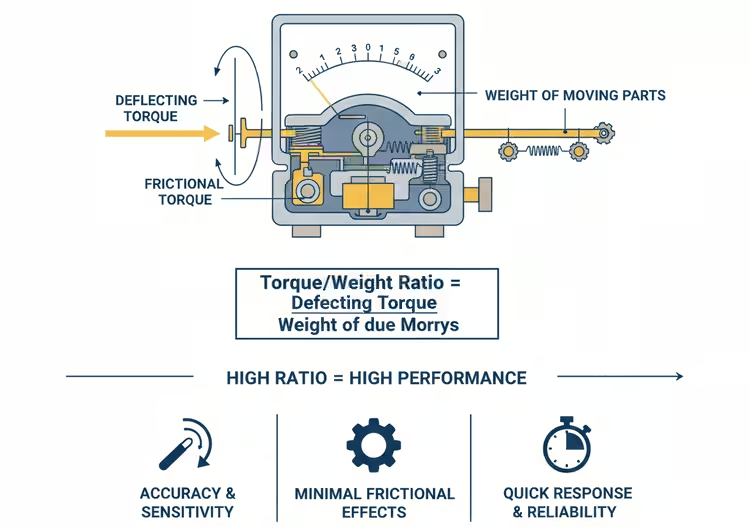
In electrical and electronic measuring instruments, accuracy, reliability, and sensitivity are critical performance factors. One key parameter that directly influences these characteristics is the Torque/Weight Ratio.
This ratio plays a vital role in ensuring that the pointer of an indicating instrument moves freely, responds accurately to the measured quantity, and avoids errors caused by friction.
What is Torque/Weight Ratio?
The Torque/Weight Ratio is defined as the ratio of:
- Deflecting Torque (torque produced by the measurand to move the pointer)
to Weight of the Moving Parts of the instrument.
$$\text{Torque/Weight Ratio} = \frac{\text{Deflecting Torque}}{\text{Weight of Moving Parts}}$$
This ratio is an indicator of the performance and quality of design of an instrument. A higher ratio means the instrument is more reliable and sensitive.
Why Torque/Weight Ratio is Important?
1. Effect of Frictional Torque
The friction in bearings or pivots of the instrument produces frictional torque, which opposes the movement of the pointer.
- If moving parts are heavy, friction becomes large.
- When frictional torque is comparable to deflecting torque, the pointer movement becomes inaccurate and unpredictable.
This leads to:
- Error in indication
- Variation in readings depending on movement direction
- Slow response
A high Torque/Weight Ratio reduces the influence of friction, thereby improving accuracy.
2. Sensitivity & Reliability of Indications
When the deflecting torque is much greater than the frictional torque:
- Pointer movement is smooth
- Indications are repeatable and reliable
- Instrument responds quickly to changes in the measured signal
Thus, a higher ratio ensures better dynamic and steady-state performance.
Recommended Torque/Weight Ratio
In well-designed instruments:
- The deflecting torque, expressed as the force acting at 1 cm radius for full-scale deflection,
- Should have a Torque/Weight Ratio ≥ 0.1 (as far as possible).
This ensures that friction has negligible impact on the pointer movement.
Engineering Perspective
Modern measuring instruments such as:
are designed with lightweight moving systems (aluminium, alloys) and high-efficiency torque-producing mechanisms, ensuring a high torque/weight ratio.
This enhances:
- Response time
- Accuracy
- Long-term stability
- Performance under vibration
Conclusion
The Torque/Weight Ratio is a critical design parameter that ensures:
- Minimal frictional effects
- High sensitivity
- Accurate and consistent readings
- Smooth pointer movements
A high torque/weight ratio reflects a well-engineered instrument suitable for precise electrical measurements.
Related posts:
 Permanent Magnet Moving Coil (PMMC) Instrument
 Moving Iron Instruments – Attraction and Repulsion Type
 Electrodynamometer Instruments – Ammeter, Voltmeter and Wattmeter
 Damping Systems – Air friction, Fluid Friction & Eddy Current Damping
 SI Units (International System of Units): Types, Advantages and Disadvantages
 Types of Errors in Measuring Instruments – Gross, Systematic and Random Error
 Thermistor Sensor: A Comprehensive Guide
 Accuracy and Precision in Measurements : Key Differences
 Moving Iron Instruments: Advantages and Disadvantages Explained
 Hydrograph: Understanding Components, Types & Applications