
A servo drive is an electronic amplifier that receives a command signal and adjusts the power supplied to a servo motor to achieve precise motion control. It’s the unseen force behind the smooth operation of robots, CNC machines, conveyor systems, and countless pieces of industrial equipment. Yet, choosing the wrong servo drive can lead to inefficiency, instability, and costly downtime.
Selecting the right servo drive is more than matching voltage ratings; it’s about understanding the interaction between control electronics, mechanical load, and environmental conditions. Engineers must balance torque, power, feedback, and scalability while considering the system’s long-term needs.
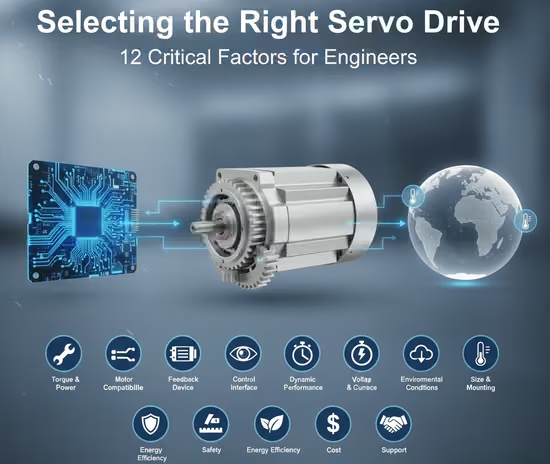
In this article, you’ll learn how servo drives work, the main types available, and the 12 essential factors to consider when selecting one. Whether you design automation systems or maintain production lines, mastering these fundamentals ensures your equipment performs at peak precision.
What Is a Servo Drive and Why Does It Matter?
A servo drive is a motion control device that interprets low-power command signals from a controller and sends high-power signals to a motor to control its position, speed, and torque. It acts as the central intelligence that makes automation reliable and precise.
Servo drives matter because they directly influence how accurately and efficiently a system can execute motion commands. In robotics, they enable synchronized multi-axis movement. In CNC machinery, they ensure precise tool control and surface finish. In packaging lines, they provide repeatability and consistency.
Choosing the right drive ensures that every part of your automated system, from the motor to the controller and mechanical load, works in harmony to achieve optimal performance, safety, and longevity.
How Does a Servo Drive Work?
Servo drives operate on a closed-loop feedback principle. They continuously compare the command input, which represents the desired position or velocity, with the actual feedback signal from the motor’s sensor. When a difference occurs, the drive adjusts the output voltage and current to correct the error.
A well-designed servo drive performs these corrections thousands of times per second, maintaining stable and precise motion even under varying load conditions.
Main stages of servo drive operation include:
- Receiving and interpreting command signals from the motion controller
- Comparing feedback from encoders or resolvers to target values
- Adjusting motor output in real time to correct deviations
- Ensuring consistent torque, position, and speed accuracy
What Are the Main Types of Servo Drives?
Servo drives are typically classified based on how they process control signals and feedback. Each type offers unique advantages depending on the application and performance requirements.
The three main types are:
- Analog Servo Drives – Use continuous voltage signals. Ideal for simpler systems requiring steady but less complex control.
- Digital Servo Drives – Use digital communication and offer advanced control algorithms, higher accuracy, and diagnostic features.
- Integrated Servo Drives – Combine the drive, motor, and controller into a single compact package for decentralized systems.
Among these, digital servo drives dominate modern automation because of their speed, precision, and compatibility with networked industrial environments. For engineers comparing models, resources such as the AMC Servo Drive Selection Guide provide valuable guidance on matching drives to motion systems.
The 12 Critical Factors Every Engineer Should Consider
Selecting a servo drive involves evaluating multiple parameters that define how well it fits your system’s needs. These are the 12 critical factors every engineer should weigh before making a decision:
- Torque and power requirements
- Motor compatibility
- Feedback device type
- Control interface and communication protocol
- Voltage and current ratings
- Dynamic performance
- Environmental conditions
- Size and mounting configuration
- Safety and protection features
- Energy efficiency
- Cost and lifecycle value
- Supplier support and scalability
Each of these factors plays a crucial role in ensuring the servo system performs as intended and lasts as long as expected.
How to Determine Torque and Power Requirements
The first and most critical step is determining how much torque and power your motor must deliver under real operating conditions. Torque is the rotational force, while power is the rate at which that force is applied.
Engineers typically calculate required torque by assessing load inertia, friction, acceleration, and deceleration. When torque and speed curves overlap with a drive’s capabilities, the system can operate efficiently without strain.
Key parameters include:
- Load mass and geometry
- Acceleration rate and motion profile
- Continuous and peak torque demand
- Duty cycle and application speed
How Does Motor Compatibility Affect Drive Selection?
A servo drive and motor must be electrically and mechanically compatible. Their voltage, current, and control feedback must align for the system to function correctly.
Mismatched components can lead to inefficient operation or complete communication failure. For example, pairing a drive with the wrong motor feedback type can cause oscillations or overheating.
To ensure compatibility, engineers should verify manufacturer specifications for rated current, motor constants, and supported feedback options before integration.
Why Does the Feedback Device Type Matter?
Feedback devices such as encoders, resolvers, and Hall sensors provide the servo drive with real-time data on motor position and speed. The accuracy of this information directly determines control precision.
Encoders offer high resolution and are ideal for precision positioning. Resolvers are robust and work well in harsh conditions. Hall sensors provide basic feedback for less demanding systems.
Feedback Device Accuracy Durability Cost Typical Use
Encoder High Moderate Medium CNC, robotics
Resolver Moderate High Medium Industrial machinery
Hall Sensor Low High Low Basic servo systems
Which Control Interfaces and Communication Protocols Are Common?
Modern servo drives connect to controllers through standardized communication protocols that determine speed, synchronization, and diagnostics.
Common interfaces include:
- EtherCAT – High-speed, deterministic communication ideal for multi-axis systems
- CANopen – Robust and widely used in industrial automation
- Modbus – Simple and cost-effective for less complex networks
- Ethernet/IP – Integrates well with factory-wide systems
Choosing the right interface ensures your system communicates seamlessly with other components.
How Important Are Voltage and Current Ratings?
Voltage and current ratings define the electrical compatibility between the servo drive and motor. If they don’t match, efficiency drops, and the components may overheat or fail.
Low-voltage drives (24–80 V DC) are suitable for small automation devices. Medium-range drives (100–400 V AC) suit industrial applications, while high-voltage models (480 V AC and above) power large servo systems. Matching these ratings ensures both performance and safety.
What Defines a Servo Drive’s Dynamic Performance?
Dynamic performance refers to how quickly and accurately a servo system responds to changing commands. It depends on bandwidth, loop tuning, and feedback speed.
High-performance drives achieve fast response times, minimal overshoot, and precise motion tracking. For demanding applications like pick-and-place robotics or semiconductor positioning, dynamic performance is often the key differentiator.
Why Should You Consider Environmental Conditions?
Servo drives operate reliably only within their environmental limits. Temperature extremes, dust, vibration, and moisture can all impact electronic components.
Engineers should always verify enclosure ratings (IP standards) and cooling requirements.
Key environmental factors include:
- Ambient temperature and humidity
- Exposure to dust or corrosive substances
- Shock and vibration levels
- Mounting orientation and airflow
How Does Size and Mounting Configuration Influence System Design?
Physical size and mounting flexibility determine how easily a servo drive integrates into an existing system. Smaller, panel-mounted units fit compact machines, while larger drives with heat sinks require ventilated cabinets.
Integrated servo solutions save space but may limit customization, whereas modular systems allow upgrades and expansion.
What Safety and Protection Features Should You Look For?
A reliable servo drive includes built-in protection features that prevent costly failures and safeguard personnel.
Five essential protection mechanisms are:
- Over-voltage protection
- Over-current protection
- Short-circuit detection
- Over-temperature shutdown
- Emergency stop integration
These features collectively extend the lifespan of both drive and motor while ensuring safe operation.
What Makes a Servo Drive Energy Efficient?
Energy-efficient servo drives minimize losses and effectively reuse power. Drives that include regenerative braking can return energy to the grid rather than waste it as heat.
Energy-saving features include:
- Regenerative energy recovery
- Power factor correction
- High-efficiency switching design
- Smart standby modes
In large automation systems, these technologies significantly reduce operational costs.
What Is the True Cost of a Servo Drive?
Servo drives vary widely in cost, from around $300 for compact models to $3,000 or more for high-end, multi-axis systems.
Five main factors influence pricing:
- Power and torque capacity
- Brand and build quality
- Supported communication protocols
- Feedback and safety options
- Technical support and warranty
A balanced evaluation of cost versus performance ensures you invest in a drive that provides lasting value.
How Important Is Supplier Support and Scalability?
Supplier support is often the overlooked factor that determines long-term satisfaction. Reliable manufacturers offer detailed documentation, firmware updates, and technical assistance that simplify integration.
Scalability also matters; choosing a vendor whose servo drives can grow with your system saves redesign costs later.
Common Mistakes Engineers Make When Selecting Servo Drives
Even experienced engineers can overlook key considerations during selection.
Common mistakes include:
- Ignoring the inertia mismatch between the motor and the load
- Under-sizing drives for peak demand
- Neglecting thermal management
- Overlooking feedback resolution requirements
- Failing to verify control protocol compatibility
- Skipping environmental condition checks
Advantages of Selecting the Right Servo Drive
Choosing the right servo drive offers multiple advantages beyond performance.
Main benefits include:
- Improves accuracy and repeatability
- Reduces energy consumption
- Increases system lifespan
- Enhances motion smoothness
- Simplifies maintenance and diagnostics
When integrated correctly, these advantages compound to deliver measurable productivity improvements.
How to Choose the Best Servo Drive Step by Step
Selecting a servo drive is a structured process that can be broken down into six essential steps:
- Define your application’s torque, speed, and accuracy needs
- Evaluate load characteristics and motion profiles
- Select a compatible motor and feedback device
- Match voltage and current specifications
- Ensure safety and environmental compliance
- Confirm supplier support and long-term scalability
By following this sequence, engineers can narrow down choices confidently and design systems that perform as intended.
Real-World Example: Servo Drive Selection in a Robotic Arm
A six-axis robotic arm used in electronics assembly requires precision torque control and compact integration. Engineers analyzed its motion profile and selected digital servo drives capable of microsecond-level feedback updates.
This optimization improved positioning accuracy by 15% and reduced energy consumption. A key factor was pairing the appropriate feedback type with the control protocol. Such projects often benefit from combining motion intelligence with visual display systems, such as LED Display Systems for Industry, which provide real-time process visualization to operators.
Conclusion
Servo drives are the backbone of modern motion control systems, translating digital commands into precise physical action. Selecting the right one ensures a balance between performance, safety, and efficiency.
By evaluating all 12 factors carefully, from torque needs to supplier scalability, engineers can design systems that run smoother, last longer, and deliver measurable returns.
Related posts:
 What is CNC Machining? | Definition, Processes, Components & More
 Transformer Bushing Types : RIP Bushing vs OIP Bushing
 Miniature cells and Batteries – Silver Oxide, Mercury and Lithium Cells
 DC Generator Problems and Solution: EMF Equation of DC Generator
 Beginner’s Guide to Separately Excited DC Generator
 Understanding Mold Flow Analysis
 DC Motor Problems and Solution – Step by Step
 Enhancing Manufacturing Efficiency: The Crucial Role of Quality Industrial Hinges
 How To Program Garage Door Opener
 Why Maintenance Neglect is the #1 Cause of Industrial Accidents