
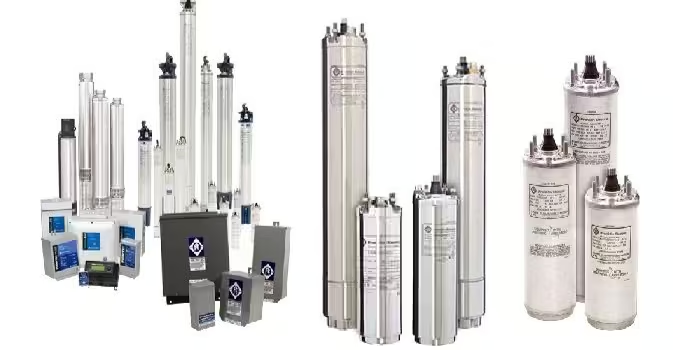
Introduction: Why Submersible Pumps Matter
The term Franklin Electric submersible pump immediately brings to mind dependable water movement in places where consistency is non-negotiable.
Whether it’s an agricultural farm pulling groundwater during peak summer or a city apartment complex relying on stable water pressure, these systems quietly handle the heavy lifting.
What makes them fascinating is how they combine durability with adaptability, making them the backbone of many modern water infrastructures.
I first encountered submersible pumps while working with a small vineyard in California.
The owners had been struggling with uneven irrigation.
The old centrifugal pump they used broke down every couple of months, leaving their vines thirsty during crucial growing weeks.
Switching to a submersible system changed everything.
Water flow stabilized, the energy bill dropped, and maintenance calls became rare.
Franklin Electric submersible pump solutions have become the trusted choice for farms, factories, and homes because they’re engineered for demanding real-world scenarios, not just lab testing.
How Submersible Pumps Actually Work
At its core, a submersible pump is designed to operate while being fully submerged in water.
This design isn’t just a clever trick—it prevents pump cavitation, a common issue in other systems where air bubbles disrupt performance.
The motor and pump are sealed to keep water out, which means the device runs quietly and efficiently under pressure.
Unlike above-ground pumps, submersibles don’t waste energy pulling water upward.
Instead, they push water to the surface with direct force.
That small difference translates into huge energy savings over time, especially in deeper wells or large-scale irrigation.
A contractor once explained it to me in simple terms:
“Think of it like pushing a ball out of a swimming pool versus pulling it up with a rope.
One takes a fraction of the effort because the water itself helps you.”
Where These Pumps Make the Biggest Impact
Agriculture and Irrigation
For farmers, water consistency is survival.
A faulty pump can mean acres of crops withering in the sun.
Submersible systems excel in this environment because they can handle heavy usage, varying water tables, and even sandy conditions without constant breakdowns.
I remember visiting a citrus farm in Arizona that ran hundreds of sprinklers off a deep well.
The farmer told me that switching to a submersible setup saved his operation nearly $8,000 in repair and electricity costs within the first year.
Residential and Urban Water Supply
Urban developers lean heavily on submersible technology for apartment complexes, high-rises, and municipal systems.
They ensure steady pressure so that water reaches the top floor without hiccups.
For households, these pumps often run quietly in the background, keeping taps and showers flowing without anyone realizing the complexity beneath the surface.
Industrial Applications
Factories depend on water for cooling, processing, and cleaning.
Industrial submersible units are built to withstand extreme workloads and run for years without major service interruptions.
In one case I saw, a food-processing plant avoided costly downtime during peak production simply because its submersible pumps kept running even when other systems in the area failed during a heatwave.
Advantages That Stand Out
Energy Efficiency
Energy efficiency isn’t just a buzzword—it directly impacts operating costs.
Because submersible pumps push instead of pull, they require less energy, making them ideal for deep wells and continuous use.
Reliability Under Stress
These pumps thrive under pressure.
Whether submerged 200 feet underground or running 24/7 in a factory, they’re engineered to handle tough environments without giving out.
Low Maintenance
Sealed motors keep dirt, dust, and debris out.
For owners, that means fewer technician visits and lower lifetime costs.
A local plumber once told me, “If you install one right, you probably won’t hear from the customer for years—except maybe when they call to say thanks.”
Common Challenges and How to Overcome Them
No system is perfect, and submersible pumps have their own quirks.
One challenge is installation—if not lowered and sealed properly, problems arise.
Another issue is power supply consistency; sudden voltage drops can harm the motor.
The good news?
Both challenges are avoidable with the right planning.
Using surge protection devices, following manufacturer guidelines, and working with experienced installers prevent most problems before they happen.
Real-Life Lessons From the Field
I once helped a rural homeowner who was tired of hauling buckets from a community well.
After installing a submersible unit, he not only had running water but also enough pressure to run sprinklers for his garden.
The pride on his face when he watered his lawn for the first time said everything.
In another project, a construction company relied on submersible pumps to drain excavation sites.
Without them, projects would stall after every heavy rain.
The pumps allowed them to stay on schedule, saving thousands in potential delays.
These real-life stories prove that pumps are more than mechanical tools—they’re problem solvers that directly improve quality of life and business stability.
Sustainability and Future Innovations
Sustainability has become a top priority in engineering.
Submersible pumps fit into this movement naturally because of their energy efficiency and longevity.
By reducing power consumption and minimizing waste from frequent replacements, they contribute to greener water systems.
Future designs are expected to integrate smart sensors, enabling real-time monitoring of performance and energy use.
Imagine a pump that sends alerts to your phone when maintenance is due or detects leaks before they become disasters.
That’s the direction the industry is heading.
Why Engineers and Homeowners Choose Them
Ultimately, engineers, contractors, and homeowners all point to the same reasons for choosing submersible systems: reliability, efficiency, and peace of mind.
When water is essential, downtime isn’t an option.
These pumps deliver consistent performance whether you’re managing a farm, running an industrial plant, or just making sure your household has water on demand.
Conclusion
The Franklin Electric submersible pump has become a quiet hero in water management.
It supports farms during drought, keeps apartment showers running, and prevents industrial shutdowns.
Every story I’ve encountered highlights one truth: when water matters most, submersible pumps keep life moving smoothly.
Related posts:
 How to Test Percentage Impedance of Transformer?
 Amplidyne – Working and Application
 3 Methods of Magnetizing a Steel Bar
 Types of Hydraulic Pumps and How They Work
 What is CNC Machining? | Definition, Processes, Components & More
 Top Educational Resources and Software for Understanding Electrical Machines
 Magnetic Hysteresis – Hysteresis Loss and Hysteresis Loop
 Difference Between Induction Motor and Synchronous Motor: Key Distinctions Explained
 Electrical Services for Residential Renovations and Expansions
 Electrical Installation of Occupied Bathroom Lights and Restroom Occupied Light Systems Explained