
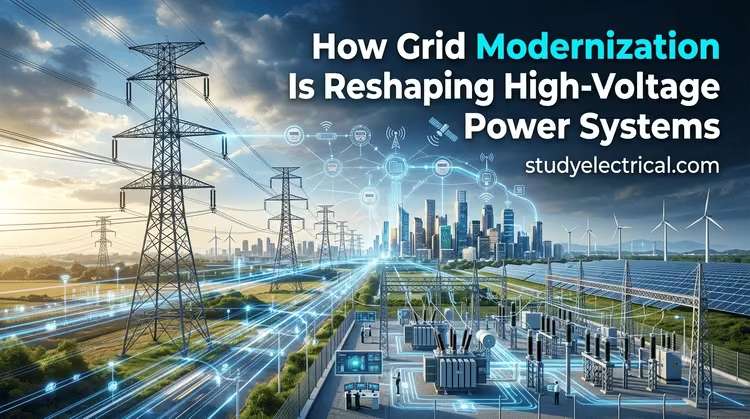
Grid modernization is the upgrade of aging power networks with digital controls, new transmission technology, and real-time monitoring so the grid can handle renewable energy, higher demand, and tighter reliability targets. For high-voltage power systems, this shift runs deeper than swapping old hardware for new. As more variable generation and longer transmission links come online, holding voltage constant and controlling reactive power becomes harder, which is why devices such as shunt reactors sit at the center of many modernization plans.
This article explains what grid modernization means for high-voltage systems, the technologies driving it, and the engineering challenges that come with rebuilding a grid that was never designed for the way we use electricity today.
What Grid Modernization Really Means
The traditional grid was built for one-way power flow. Large central plants generated electricity, high-voltage lines carried it long distances, and distribution networks delivered it to homes and factories. Control was limited, and operators had little visibility into what happened between substations.
Modernization changes that model in a few ways:
- Bidirectional flow. Rooftop solar, wind farms, and battery storage now push power back into the network, so the grid has to manage electricity moving in both directions.
- Digital visibility. Sensors and communication networks give operators live data on voltage, current, and equipment health instead of periodic manual readings.
- Automated response. Protection and control systems act on that data in milliseconds, rerouting power or isolating faults without waiting for a human command.
For high-voltage systems specifically, modernization means transmission lines, substations, and the equipment inside them are being re-engineered to carry more power, respond faster, and stay observable at every point.
Why the High-Voltage Grid Is Being Rebuilt
Several pressures are forcing utilities to act at once.
Aging infrastructure: Much of the world’s high-voltage network was built decades ago. Transmission lines, power transformers, and the transformer bushing that carries current safely through a transformer’s grounded tank are often past their original design life. Replacing or refurbishing this equipment is a large part of any modernization program.
Renewable integration: Wind and solar plants usually sit far from the cities that consume the power, and their output changes with the weather. That forces new long-distance transmission and new ways to keep the system stable when generation swings up and down.
Rising and shifting demand: Electric vehicles, data centers, and the electrification of heating are pushing demand higher and moving where and when peaks occur. The grid has to carry more energy to new places.
Reliability and resilience: Storms, heat waves, and wildfires stress the network. Utilities and regulators now expect the high-voltage backbone to ride through disturbances and recover quickly.
Smarter Monitoring of Aging High-Voltage Assets
One of the quieter shifts in modernization is how operators care for equipment that is still in service. The old approach was time-based, meaning crews inspected and overhauled on a fixed schedule whether the asset needed it or not. The modern approach is condition-based, driven by data from the asset itself.
High-voltage transformers, bushings, and cables now carry sensors that track temperature, dissolved gases in insulating oil, and insulation behavior under load. One of the most useful early-warning signals is partial discharge testing, which detects small electrical discharges inside insulation long before they grow into a full breakdown. Continuous monitoring lets a utility catch a developing fault, plan a repair, and avoid an unplanned outage.
The payoff is practical. Instead of pulling healthy equipment out of service or discovering failures the hard way, operators fix what actually needs fixing when it needs it.
HVDC and the Push for Long-Distance Transmission
Moving bulk renewable power across long distances is where high-voltage direct current (HVDC) has become central. HVDC carries large amounts of power over long overhead lines and undersea cables with lower losses than AC, and it lets operators connect networks that run at different frequencies.
The scale of the rebuild ahead is large. The International Energy Agency’s first global stocktake of grids found that meeting national climate and energy goals will require adding or refurbishing more than 80 million kilometers of grids by 2040, roughly equal to the entire existing global grid, with annual grid investment needing to double to over USD 600 billion by 2030. A large share of that build-out is high-voltage transmission meant to connect renewable projects waiting in grid queues.
Two HVDC technologies dominate. Line-commutated converters (LCC) handle very high power over point-to-point links. Voltage-source converters (VSC) are more flexible, support weaker grids, and make multi-terminal DC connections possible, which matters for offshore wind.
Digital Substations and Real-Time Control
Substations are where much of the visible modernization happens. A traditional substation relied on copper wiring and electromechanical relays. A digital substation replaces most of that with fiber-optic communication and intelligent electronic devices built around the IEC 61850 standard.
This brings a few concrete changes:
- Sensor data travels over a process bus instead of hundreds of copper cables, which cuts wiring and simplifies maintenance.
- Phasor measurement units (PMUs), also called synchrophasors, sample voltage and current many times per second and time-stamp each reading against GPS, giving operators a synchronized view across a wide area.
- Wide-area monitoring systems use that data to spot instability building across the network, not just at a single substation.
The result is a substation that reports its own status continuously and can be reconfigured remotely.
Managing Voltage and Reactive Power With More Renewables
A grid with heavy renewable penetration is harder to hold at the right voltage. Long, lightly loaded lines can push voltage up, while a sudden drop in wind or solar output can pull it down. Controlling that swing is a core modernization task.
Utilities handle it with reactive power compensation. Shunt reactors absorb excess reactive power on long transmission lines, capacitor banks supply it where voltage sags, and FACTS (flexible AC transmission systems) devices adjust both quickly using power electronics. Together they keep voltage inside safe limits as generation shifts through the day.
Protection, Automation, and Cybersecurity
Faster, more automated protection is another pillar of the modern grid. Adaptive protection schemes change their settings as network conditions change, and self-healing systems isolate a faulted section and restore power to the rest within seconds.
That connectivity carries a cost. A grid full of networked devices is exposed to cyber threats that never touched the old electromechanical system. Utilities now treat cybersecurity as part of grid design, with network segmentation, encryption, and monitoring built into control systems from the start rather than added later.
The Challenges of Modernizing High-Voltage Infrastructure
None of this is simple to deploy. The main obstacles are consistent across regions:
- Cost and financing: Upgrades run into billions, and someone has to fund them without pushing electricity prices out of reach.
- Interoperability: Equipment from different vendors and different decades has to work together, which puts heavy weight on standards like IEC 61850.
- Legacy integration: Utilities cannot switch off the grid to rebuild it, so new technology has to be phased in alongside equipment that will stay in service for years.
- Skills: A data-driven grid needs engineers who understand both power systems and software, and that workforce is still catching up.
Where High-Voltage Grids Are Headed
The direction of travel is clear even if the timeline is not. A few developments are moving out of pilot projects and into wider use:
- Digital twins that mirror a physical asset or substation in software, letting operators test changes and predict failures before they happen.
- AI-assisted asset management that turns years of sensor data into maintenance decisions.
- Grid-forming inverters that let renewable and battery resources help stabilize the grid the way large rotating generators once did.
- Multi-terminal HVDC grids that link several regions and offshore wind zones into a shared DC network.
Frequently Asked Questions
1. What is the difference between grid modernization and a smart grid?
Grid modernization is the broad effort to upgrade power infrastructure with new technology. A smart grid is the result: a network with digital sensing, communication, and automated control. Modernization is the process, the smart grid is the outcome.
2. Why is HVDC important for renewable energy?
Renewable plants often sit far from demand centers, and HVDC moves large amounts of power over long distances with lower losses than AC. It also connects grids of different frequencies and supports offshore wind through undersea cables.
3. What is a digital substation?
A digital substation uses fiber-optic communication and IEC 61850-compliant intelligent electronic devices in place of most copper wiring and electromechanical relays. It provides live status data and can be monitored and reconfigured remotely.
4. How does modernization improve reliability?
Continuous monitoring catches equipment problems early, adaptive protection isolates faults faster, and self-healing systems restore power to unaffected areas within seconds instead of minutes or hours.
5. What is the biggest challenge in modernizing high-voltage systems?
Integrating new technology into a grid that has to stay running while managing cost and keeping equipment from different vendors and eras working together. The financing and workforce gaps make it harder.
Final Thoughts
The high-voltage grid is being asked to do something it was never designed for. It has to carry variable renewable power over longer distances, respond to faults in milliseconds, and report its own condition in real time. Meeting that demand takes new transmission technology, digital substations, better asset monitoring, and protection that adapts on its own. The utilities that treat modernization as a coordinated rebuild, rather than a run of one-off upgrades, will operate the most reliable and lowest-cost grids as electricity takes on a bigger role in the energy system.
Related posts:
 Current Limiting Reactor or Series Reactor
 Shunt Reactors: Types, Working and Design
 Disconnect Switches in Substation: Types, Design and Working
 Percentage Reactance in Power System (Transformer, Generator or Reactor)
 Load Break Switches in Electrical Substations
 High Voltage Fuses: Types and Working
 Guide To Becoming An Expert In Partial Discharge Testing
 Lightning Induced Faults on Power Lines
 What is Switching Station? | Working and Layout
 Why Do We Use Transmission Switching in Electricity Supplies?