
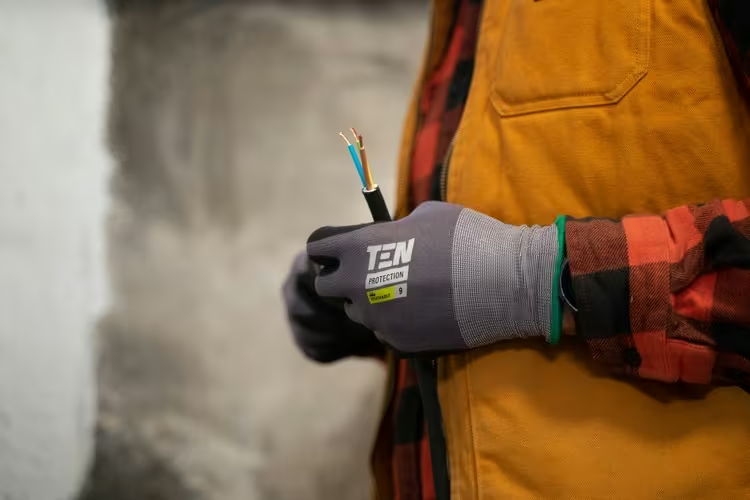
Electrical professionals face some of the most challenging environments in modern industry. From high-voltage systems to confined maintenance zones, their daily tasks often involve hazards that require precision, focus, and awareness. As the demand for skilled electrical technicians grows in offshore energy, industrial manufacturing, and marine operations, the need for robust safety training has never been greater.
Traditional technical knowledge alone is no longer enough. Workers who understand both electrical systems and emergency procedures are more valuable to employers and far better prepared for the realities of high-risk environments.
Electrical work and hazardous environments
Electricians and maintenance engineers frequently operate in conditions that demand strict safety controls. Confined spaces, flammable atmospheres, and complex isolation procedures are common across industrial facilities and offshore installations. These environments can quickly become hazardous when combined with electricity, heat, or mechanical movement.
A small lapse in procedure might trigger an arc flash, fire, or even an explosion. Technicians who perform electrical maintenance in marine or oil-and-gas facilities face additional challenges such as humidity, corrosion, and vibration. Understanding emergency response principles is vital for anyone working in such settings.
How BOSIET training bridges safety and technical work
Professionals planning to work in offshore or industrial environments can strengthen their safety competence through bosiet training. BOSIET, short for Basic Offshore Safety Induction and Emergency Training, is an internationally recognized course approved by OPITO that prepares participants for work in offshore and remote industrial sites.
The program equips electrical and maintenance workers with essential knowledge to handle emergency situations. It covers survival at sea, helicopter evacuation, firefighting, and first aid, all skills that complement technical expertise. For electrical professionals transitioning into offshore projects, this certification demonstrates readiness to work safely in challenging conditions.
Inside the OPITO-approved BOSIET course
The FMTC Safety BOSIET with EBS (Emergency Breathing System) course provides a structured learning experience that combines theory with realistic hands-on exercises. Participants receive instruction in:
- Safety induction: Understanding offshore regulations, safety culture, and hazard recognition.
- Helicopter safety and underwater escape: Learning how to evacuate safely using an emergency breathing system during helicopter transit.
- Sea survival and first aid: Practicing water survival techniques and basic medical response for offshore emergencies.
- Firefighting and self-rescue: Using extinguishers, managing confined fires, and navigating smoke-filled spaces.
- Emergency response planning: Coordinating with teams and following proper evacuation procedures.
Each part of the training aligns with real risks faced by technicians who maintain electrical and mechanical systems offshore. This immersive approach helps participants gain the confidence to act quickly and effectively during emergencies.
Confined space awareness and its relevance to electrical work
Confined spaces present one of the most common and underestimated dangers in electrical maintenance. Cable trenches, turbine housings, switchgear enclosures, and storage tanks often have limited entry points and poor ventilation. Without adequate awareness, technicians face the threat of oxygen deficiency, toxic gases, or entrapment.
BOSIET training emphasizes hazard identification, risk assessment, and communication, all essential elements when working in confined areas. The course also reinforces the importance of personal protective equipment (PPE), permit-to-work systems, and teamwork during emergencies. By integrating these practices, electrical professionals improve their ability to manage confined space operations safely.
Practical learning for real-world applications
FMTC Safety’s training model focuses on realistic scenarios that mirror real industrial and offshore environments. Participants practice underwater escape simulations, firefighting in controlled conditions, and emergency response drills designed to replicate genuine challenges.
This style of learning helps electrical technicians translate theoretical safety knowledge into practical skills. The result is a workforce that not only understands compliance but also knows how to apply it effectively during high-pressure situations.
Choosing the right training provider
When selecting a BOSIET course, professionals should look for OPITO-approved providers with proven experience and high-quality facilities. FMTC Safety is recognized for its practical approach, certified instructors, and global reach. The company ensures that every participant leaves the course not just qualified but truly capable of responding to real emergencies.
Scheduling flexibility also makes FMTC an ideal option for working professionals. Courses are offered regularly throughout the year, allowing individuals and companies to plan training without interrupting essential operations.
Taking the next step toward offshore readiness
The intersection of electrical expertise and safety knowledge is where the modern energy workforce thrives. BOSIET certification builds that connection, preparing electrical professionals to take their skills into offshore and industrial sectors with confidence.
Those ready to expand their opportunities and enhance safety awareness can explore FMTC’s bosiet training to gain internationally recognized credentials and hands-on experience. It’s a smart investment in both career growth and personal safety, two elements that define success in today’s technical world.
Related posts:
 Buy Cheap Essay: What Do Custom Sites Do for Students?
 Pay to Do My Essay: Hire Experts and Boost Your Grades
 4 Must-Have Gadgets for Electrical Engineering Students: Boost Your Learning and Productivity
How to Write an Argumentative Essay Related to Your Physics Course
4 Must-Have Gadgets for Electrical Engineering Students: Boost Your Learning and Productivity
How to Write an Argumentative Essay Related to Your Physics Course
 Balancing Work, Study, and Life Without Burning Out
 Mums’ Guide to Finding the Best AP Exam Resources Online
 Electrician Careers: 8 Specializations To Consider
 4 Tips to Write a Physics Dissertation Work
 The Timeless Spark of Electrical Engineering
 Five High-Performance Connector Technologies Every Electrical Engineer Should Know